Wednesday, December 30, 2009

Breaking the All-Grain Barrier: Burner & Boil Kettle

Yesterday I finally brewed my first "all-grain" batch of beer. It was a great brew day. Everything went smoothly, my brewing buddy Eric and I had a great excuse to hang out, and we both learned a lot. After much reading prep, I really enjoyed seeing a few things with my own eyes. For example: I had read that brewers used to (and surely still do) use the first drain-off (or "runnings") from a mash to make stronger beers, then would make lighter beers with the second and third runnings. It was really interesting to watch as the first runnings were a rich, darker color and the third runnings were much, much lighter as the grains were progressively rinsed of their sugars.

The most satisfying part of the day came when it was time to take the specific gravity reading of the collected and boiled wort. Despite our first pass at all these new procedures—the mashing of the grains, two rinses (or "sparges"), and a full-wort boil—we nailed the target reading given in the recipe. Beginner's luck? Maybe.

I had had the ingredients for an Irish red ale—purchased as an all-grain ingredient kit from Northern Brewer—for months, but had to piece together equipment. I'm going to spend the next few posts recapping my setup and explaining why I chose the items I did. Until yesterday, I had been brewing on an electric stove top in my kitchen, so I needed quite a bit of equipment to go all-grain. There are countless ways to do this but here's what I did.

Burner and Boil Kettle

I needed a stronger, outdoor heat source and a bigger brew kettle to accommodate the larger boil volumes. (Instead of boiling 2 or 3 gallons of wort in recipes that use malt extract, you boil the full 5 gallons of wort for all-grain recipes.)

I purchased a Hurricane burner and a Blichmann BoilerMaker 15-gallon kettle. I liked the burner because for the cost of a $7 orifice accessory I can choose to use it with natural gas instead of the standard propane setup. The kettle was a tougher decision. I debated long and hard about whether to go with a converted keg (also sometimes called a "keggle") or another brand of brew pot. I decided on the BoilerMaker because of the quality fit and finish of Blichmann products, the features that this specific brew pot offered, and the reportedly quicker heat-up time compared to keggles. It was a relatively expensive route to take, but I'm planning on it serving me for many years.

Once I had settled on a Boilermaker, I agonized over the decision between the 10- or 15-gallon versions. The smaller size is perfect for 5-gallon batches, while the 15-gallon would allow me to also do 10-gallon batches if I watch the pot carefully for boilovers. (Ten gallons is a batch size homebrewers typically upgrade to when doing all grain, since you get twice the amount of beer for roughly the same amount of work and just a little more cost.) Another plus for the 15-gallon size was the fact that I could easily transition it into a more advanced brewing system if that day ever came. With the addition of Blichmann's $75 false bottom, the pot, which I'm now using as a brew kettle, would make a great mash tun (the vessel in which you mash your grains) for a 10-gallon system. The drawback to the larger size: 5-gallon batches are kind of dwarfed in the pot and the great Brewmometer that comes standard on the Boilermaker is rendered useless by its placement midway up the pot. Based on my observations with yesterday's batch, you need approximately 7 gallons of liquid in the kettle to cover the thermometer's probe. Since I already have an accurate probe thermometer this was less of a concern for me. In the end, I opted for the larger size to future-proof myself somewhat.

Both the burner and the kettle performed great during yesterday's brew session. I love how quickly the burner heats—a big time saver—and the design of the Boilermaker's base (with a ridge around the edge and a depression in the middle) makes it a perfect and sturdy fit on the Hurricane burner. We did have an issue with the burner backfiring when shut down, but it was no big deal and may be a common occurrence with portable burners for all I know. Also, note that much of the nice black paint on your burner will ignite and take to the air as ash the first couple of times you use the burner. I second the recommendation I read to run the burner for a while to clear some of this paint off prior to brewing your first batch on it.

Next time I'll discuss my setup choices for a mash/lautering tun and a hot liquor tank (including more about what those terms even mean to a fledgling brewer). Thanks for reading.

Update: After several brew sessions with my setup, I posted a follow-up with more thoughts on the Blichmann BoilerMaker on August 4, 2010.

Tuesday, December 22, 2009

Teach a Friend to Homebrew Day

Sorry that I'm way behind on the blog. No shortage of content in my head; just a lack of time to get it posted. For example, I've been meaning to write for a while now about the "Teach a Friend to Homebrew" gathering I had at my house on Nov. 7—also known as Learn to Homebrew Day. I had planned to be brewing all-grain batches by then, but I decided to brew one more extract batch with some folks more fledgling than me at this event.

We brewed a recipe from the book Beer Captured. The recipe was based on Anchor Brewing's "Our Special Ale"—more specifically the 1995 iteration of their constantly changing holiday beer. None of us involved had ever had the original beer, but we were looking for something with a holiday flavor and a shorter turnaround time than the bigger holiday ales in the book. Here's the description from the book (p. 158):
The 1995 version arrives with a reddish tan whipped cream head that poses on an attractive dark mahogany brown beer. The aroma takes you back to Grandma's kitchen when she was baking spice cake. Sweet spices coat the tongue along with a malty palate. The finish is malty and redolent of vanilla.
With a handful of helpers and a dozen or so onlookers, we brewed on the stove top. While teaching friends to brew is a great concept, in reality the amount of activity and distractions took their toll. The first mistake occurred during the steeping of the specialty grains. The goal was to hold the grains in 150-degree water for 30 minutes, but my new-to-me probe thermometer, which was inserted through a vent in the brew pot's lid,  wasn't submerged. It was reading air temp in the pot, not the liquid temp. As a result, the grains steeped in the 170- and 180-degree range for 10 minutes or more. Steeping this hot is known to strip tannins from the grains and give the beer an astringent off-flavor. So we're not even past the steeping stage and I'm already keeping my fingers crossed.

The second error came with the addition of three spices that the recipe called for. Two of the spices—vanilla bean and anise—needed to be chopped before being added to the boil. The third spice, nutmeg, needed no preparation. When cleaning up after the event, I realized that we had focused on the vanilla bean and anise to the exclusion of the nutmeg. We simply forgot to add it, even though it had been set out. Fortunately this recipe is billed in the book as one that can host a mix-and-match array of spices. So while I considered adding the requested 1/4 teaspoon of nutmeg to the fermenter, I figured we should just let the beer ride as-is and see what happens.

The rest of the process, from the boil to the ice-bath cool down, went well. But when we measured the original gravity of the wort before adding the yeast, we learned we had also missed our target original gravity by a few points. The recipe calls for an O.G. of 1.068-1.069 and our wort came in at 1.065. Since I have taken so long to post a recap of this brew day, the beer has finished fermenting and I can tell you that we also missed the final gravity by an even wider margin. The recipe indicates a final gravity of 1.017-1.018 and our fermentation ended several points short at 1.026. As a result, the beer's alcohol-by-volume (ABV) measurement is 5.1%—considerably lower than the 6.5% ABV that we targeted in the recipe.

The beer is now kegged and in my keg refrigerator, and as of tomorrow night it will have been under CO2 pressure for one week. I adhere to the "set it and forget it" method of force carbonating beer, which basically means you apply CO2 to the keg at the intended serving pressure and come back in two weeks. The "Our Special Ale" recipe states the beer will be ready to drink one month after carbonation and that it will peak within two to six months. So we wait.

I want to take this opportunity to thank all the friends who came over for the event. They came with helping hands, patience and lots of great questions. I definitely plan to hold another "Learn to Brew" gathering to mark next year's homebrewer holiday—and probably sooner than that.

Saturday, November 28, 2009

Portland Debrief: Part 3

Well, it's been over a month since the trip and I'm finally wrapping up the recap of my journey to Portland, Ore. The trip was primarily a long overdue visit with a longtime friend, but you can't go to this craft beer capital without getting wrapped up in the beer culture. If you're just now tuning in, you can check out Part 1 and Part 2 to catch up.

SUNDAY

Sunday's beer-related activities started with lunch at BridgePort Brewing Co.'s brewpub. My friend Jason and I split a tasty pizza while I enjoyed two more new-to-me beers: a Blue Heron Pale Ale and a seasonal Ebenezer Ale. Both were very good, but after two pints it was time to move on to another stop.

We didn't have to go far to reach Deschutes Brewery's Portland Brewery & Public House, which like BridgePort is also located in the Pearl District. Here we had a six-beer sampler that featured Mirror Pond Pale Ale, Black Butte Porter, Obsidian Stout, Mirror Mirror oak-aged barley wine, Armory XPA, and the Dubbel-style Seafort 7 Abbey Ale. Deschutes has several beers on tap so you truly get to choose your own sampler and they'll fill it for you (unlike some breweries that only offer a predetermined sampler). Jason recommended the first three based on past experience and we kind of winged it on the last three. Of the latter trio, we got lucky with one in particular.

The Mirror Mirror barley wine, which is part of Deschutes' "Reserve Series" and clocks in at 11% alcohol by volume, was absolutely delicious. As I've mentioned before, I did not keep tasting notes (not that I even know how to properly record a tasting anyway) but Mirror Mirror was easily one of my two favorites from this trip—the other being Lompoc's Bourbon Barrel Aged Red Ale. Needless to say, I've started exploring options for incorporating bourbon-soaked oak into my homebrewing process.

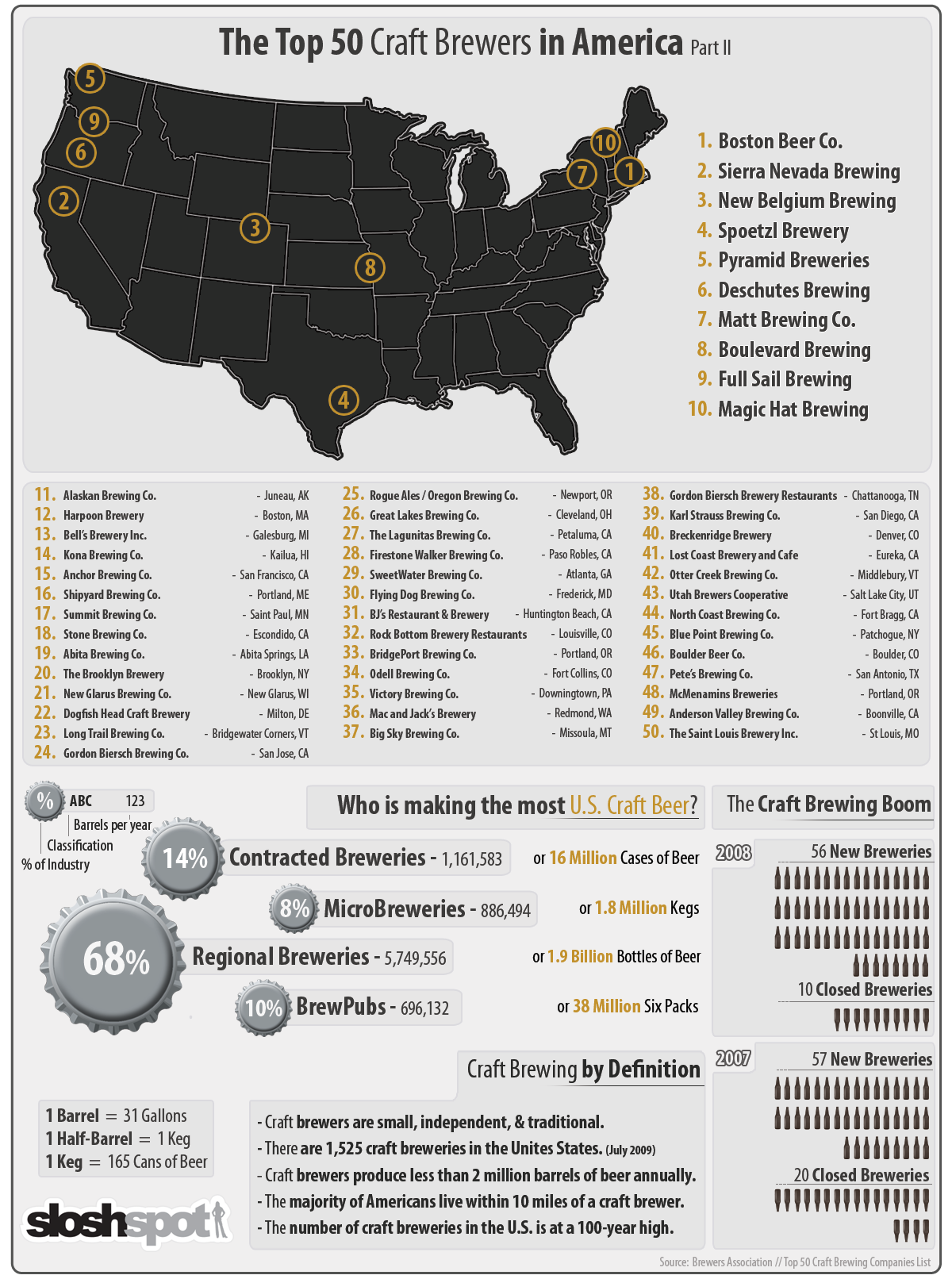
While I also really enjoyed the Mirror Pond Pale Ale, another highlight from the sampler was the Black Butte Porter. Jason and I made a new friend who sat one next stool over and raved about Deschutes' Porter offering. And he's got the judges to back him up, as Black Butte recently ranked No. 1 in the 2009 U.S. Open Beer Championship's Porter category. I was also surprised to learn since my return that Deschutes ranked sixth overall in 2008 craft brew sales, well ahead of breweries like Stone, Dogfish Head and Rogue. After sampling their offerings, I can see why.

Deschutes also offered the most amazing growler I had ever seen before—a fairly elaborate stein combining glass and metal, and sealed with a massive Grolsch-style, clamp-down cap. As we exited and returned to Jason's car (in a lucky parking spot right by the front door), I glimpsed a funny image of a youngster tasked with wrangling one of his family's proportionately massive beer vessels back to the brewery for a refill.

Our next stop was a bit farther away but my helpful host and designated driver, Jason, was keen on me trying a staple of the Northwest: MacTarnahan's Amber Ale. While the pint was great, the taproom was by far the oddest we visited. The atmosphere was an awkward mix of tradition (amazing porcelain tap towers, for example) and cookie-cutter modern (menu boards that resembled those from a chain eatery). After seeing three different names (MacTarnahan's Brewing, Portland Brewing and Pyramid Brewing) and talking with the bartender, it was easier to see why: Pyramid purchased the other two venerable Portland institutions five years ago and now oversees their operation. The good news is they are keeping the MacTarnahan's flowing. I purchased a MacTarnahan's pint glass and had samples of two other brews (their Humbug'r seasonal and the Thunderhead IPA) before we headed home.

After picking up Jason's wife, Marcelle, we headed to the vibey McMenamin's St. Johns Theater & Pub to cap my final full day in the City of Roses. Thanks to my sampler research at McMenamin's Edgefield the day before, I ordered a pint of Hammerhead Pale Ale. I was then introduced to another McMenamin's delight: the Scooby Snacks appetizer of bite-sized corn dogs. Not sure if it was the daily volume of alcohol consumed or the time that has since lapsed, but I can't remember my entree. I'm pretty sure it was my first experience paying for a meal that I ate on a couch, though.

We returned home to wind down with some videogame racing battles and I cracked open the 22 oz. Lompoc C-Note Imperial Pale Ale bottle I had bought on Saturday. After my first sip, I exclaimed to Jason, "It's assaulting my tongue!" Every taste bud was standing at attention and screaming as the beer's 100 IBU's powered their way toward my throat. While definitely a little strong for my pale ale wheelhouse, it was a very tasty beverage and one that I will surely revisit when given the opportunity.

MONDAY

Sad to leave but excited to return home to my wife and son, I packed my bags Monday morning and enjoyed a bagel before Jason chauffeured me to the airport. En route, we stopped at the post office to mail myself a box packed with 12 ounces of hops he and Marcelle had harvested from his backyard. Those will be put to good use in coming brew sessions. As we pulled up to the airport terminal, Jason bid me farewell and suggested that I visit one last brewery with a location in Concourse E: Laurelwood Brewing Company. I had just enough time to grab a sandwich and sample Laurelwood's Hooligan, an English Brown Ale, before heading to my gate and lifting off.

Fittingly, my beer-finding mission ended exactly where it started. During a layover in Salt Lake City, I made a return visit to Squatters Brewing Co. While I had opted for a sampler in this airport pub on Friday, I zeroed in on their Organic Amber Ale this time through. It wasn't the best beer I had on the trip, but the pint offered me the perfect opportunity to reflect on all the beers I had enjoyed during my four-day crash course in Portland beer culture.

Tuesday, November 3, 2009

Portland Debrief: Part 2

On Oct. 23-26, I visited my friends Jason and Marcelle in Portland, Oregon, and got to sample some of what this craft beer capital has to offer. In total, I tried 38 news beers during the trip—a great learning experience for a new brewer and novice beer geek like me. It was like our own mini Great American Beer Festival. (See the previous post for Part 1 of the recap.)  

SATURDAY

Day 2 of my Portland trip started off with some much needed protein fortification—a tasty bacon-and-eggs breakfast. Jason, Marcelle and I spent much of our time at the house tormenting each other in racing or flight simulator videogames on the PS2, but this Saturday was shaping up to be an uncommonly sunny day in Portland. So we hit the road.

So did everyone else in Oregon, apparently. Our first stop, McMenamin's Edgefield, was slammed. This sprawling compound features a hotel, a restaurant, a brewery, a winery, a distillery, a 3-par golf course, several gardens and much more. It's great to see an organization like McMenamin's (which, according to its Web site, operates "more than 55 (and counting) neighborhood gathering spots in Oregon and Washington") be so successful while serving primarily their own beer alongside their food. Apparently they recently caved to include a couple of beers from the Big Three (Anheuser-Busch, Miller, and Coors) on the menu, but everything else is their own creation.

We skipped the line waiting for a table inside the estate's pub, called The Power Station, and grabbed three open seats at the end of the bar. We ordered the six-beer sampler and dug in. There was a lot to like among the Ruby Ale, Hammerhead Pale Ale, Sunflower IPA, Black Rabbit Porter, Terminator Stout and summer seasonal Copper Moon. My favorites were Ruby and Hammerhead. We also devoured an order of spinach-artichoke dip and chicken wings before elbowing our way back through the throngs who were waiting to be seated.

Next, we settled on the Pearl District's Rogue Ales Public House, which was also jumping thanks to a wedding reception underway at Rogue's adjoining distillery. We grabbed a sampler at this pub as well, tasting the Brutal Bitter, the Juniper Pale Ale, the Rogue Red and the Chocolate Stout. All were tasty aside from the Brutal Bitter, which I didn't care for. Before we left, I fulfilled one of my goals of the trip: having a draft Dead Guy Ale from Rogue's own tap. And since I didn't try to plant a sloppy kiss on the bride—or the groom—Jason and Marcelle allowed me to continue the day's tour.

Next up was Old Lompoc Brewery's Fifth Quadrant location. I had read about Lompoc (and more specifically their C-Note Imperial Pale Ale) in the tiny bit of pre-trip scouting I had done. Lompoc Fifth Quadrant is a restaurant/pub, but while we were trying to decide whether to sit at the bar or take a table a bartender said, "If you are only here for beers, the Sidebar is open for another 50 minutes." And she pointed off around the corner. And as it turns out, I was very glad she did.

We made our way around the corner and half a block to a section of the building that featured a large painted mural on the wall, a small sign and one open door. This dimly lit room with a stool-less bar, a few tables and about two dozen oak barrels full of fermenting beer only contained two people. And one was the bartender. Both were quite friendly and the patron later told me that he's been to the location pretty much every weekend since it opened. Just as the hours for the Sidebar are more exclusive, so are the beers they serve. This tasting room focuses on special batches (including ones fermenting in the oak barrels in the very same room) and seasonals.

Only six beers were on tap here, and none was the C-Note Imperial Pale Ale that I wanted to try. I was torn. We left to return to the larger restaurant/bar area that had C-Note but stopped along the way at Pix Patisserie, a decadent chocolatier on the corner. While Jason and Marcelle surveyed the mouth-watering display case, I kept thinking about the Bourbon Barrel-Aged Red Ale that was listed on tap at the Sidebar. Plus, the Sidebar sold the C-Note in 22 oz. bottles. So I quickly decided I would go drink a pint of the red ale and buy a bottle of C-Note to go. I asked Jason and Marcelle to meet me at the Sidebar when they were done at the chocolate shop.

Upon my return to the Sidebar, the bartender asked me, "Did you ditch your friends?" I explained they were at Pix and I then had a small sample of the Bourbon Barrel-Aged Red Ale, which as I recall had been brewed in 2007. It was delicious, with hints of bourbon as you might expect, so I ordered a glass. The snifter was a little over half full when the tap went dry—I had finished off the batch. I was instantly intrigued by the fleeting nature of this place and would certainly make this a regular stop if I was a local.

When Jason and Marcelle arrived from Pix, the bartender addressed them, "You guys just had chocolate? Try this," and poured them each a sample of Barrel Fermented Sockeye Stout. They both loved how it went with the chocolate, and Marcelle noted that Lompoc should put a stout-touting sign pointing from Pix toward the Sidebar. I sampled the stout, finished off my red ale and bought a Lompoc pint glass and a bottle of C-Note on our way out. (The affable bartender didn't even charge me for the superb half-beer I had been savoring: "It was basically a large sample," he said.)

Our final stop of the day was dinner at Gustav's on N.E. Sandy Boulevard. The friendly service continued there with our helpful waiter, who recommended an entree for me. To accompany it, I selected another new-to-me beer, the Spaten Oktoberfestbier Ur-Märzen. I wasn't keeping tasting notes this trip, but the beer, the friendship and the hearty German meal forged a fabulous culmination to a great October day in Portland.

Sunday, November 1, 2009

Portland Debrief: Part 1

My trip to Portland Oct. 23-26 was fantastic. I had a great time visiting friends Jason and Marcelle, and these two newlyweds were superb hosts—cooking scrumptious food from scratch, setting me up with possibly the world's most comfortable air mattress/feather bed, introducing me to Ricky Gervais' squirmingly funny show "Extras," and hauling me all over Portland to let me try new beers. In fact, I tasted an amazing 38 beers in four days. Thanks again to Jason and Marcelle for a wonderful visit.

FRIDAY

My trip started with a 6:10 a.m. flight from Nashville Friday morning. During a two-hour layover in Salt Lake City, I happened upon a Squatters brew pub in Concourse C and ordered a sampler. It was a little early in the day (9:30 a.m. Mountain Time) for me to be drinking alcohol, but it was 10:30 in Nashville and I was on vacation—a beer-finding mission, no less—so I easily rationalized the decision. The sampler featured six beers from the Utah-based brewery: Provo Girl Pilsner, Chasing Tail Golden Ale, Full Suspension Pale Ale, Organic Amber Ale, Captain Bastard's Oatmeal Stout, and the underwhelmingly named Hefeweizen. My favorites: Organic Amber Ale and Full Suspension Pale Ale.

Upon landing in Portland, I was heading toward baggage claim when I noticed a Rogue Ales location. In the Airport. At this point I knew it was going to be a good trip.

Jason picked me up and after enough time to drop my bags and take a quick tour of their great house,  we were off to a nearby brewery, Roots Brewing Co. We sampled a few of their on-tap creations and I settled on a pint of their Gruit Kolsch summer seasonal. It marked my first Kolsch-style beer. I thought it tasted quite different than any beer I had had before, only to later read that it was a hop-free beer. (Oh, the horror, right?) It's brewed with organic malt alongside chamomile and lavender flowers from the brewery's organic garden. A tasty, easy-to-drink beverage, if a little out of season for 50-degree weather.

We returned to Jason's to eat his delicious pizza and unwind while enjoying bottled Full Sail Pale Ale that he had on hand. As a beer that Jason counts as one of his favorites, it was a fitting ending to my first day in Portland.

Next up: A busy—and buzzy—Saturday in Portland.

Thursday, October 15, 2009

Going With the Grain

It's been a while since I've brewed a batch. Trying to align the busy schedules among our six-member brewing crew, The Hoplings, isn't easy. So I've been spending the past couple of months reading books, Web sites, and magazines about beer and beer-making while collecting the necessary equipment to brew "all-grain" batches.

For those very new to brewing, there are essentially three versions of a homebrewing recipe. There's the extract version, which is considered the easiest method since it requires less time and know-how. It's kind of like buying pre-made pasta sauce when making spaghetti. As with commercial sauces, there is a wide variety of malt extracts available—both dry and liquid, and with a range of color and flavor characteristics—but you are still limited to what is on the shelf.

All-grain brewing, by contrast, is like making the pasta sauce from scratch, and is thereby considered more challenging than extract brewing. Instead of buying malt in a prepared form (already extracted by companies called maltsters), an all-grain brewer purchases types of grains, cracks them with a mill, and uses a heating process called "mashing" to withdrawal and collect the sugary water that is a key ingredient in beer. (Mashing is different than "steeping," by the way. I'll be covering the topic of mashing in greater detail as I begin to brew all-grain batches.) Carrying on with the pasta analogy, this method allows you to customize your sauce, making it thicker or thinner, more or less potent, and unlike anything you can buy in a store. In fact, there are no available extracts for certain types of grains used in beer-making.

The third approach to a beer recipe is called a "partial mash," which is viewed as an intermediate stage between extract and all-grain brewing. It's similar to jazzing up a basic, store-bought pasta sauce with some other ingredients you prefer: you conduct a small-scale mash and then use malt extract to bring the amount of fermentable sugars to the desired level.

I used to believe there was little difference between the three methods and that you could use whichever you wanted depending on the time and money you had available. See, all-grain brewing takes longer but can be cheaper in the long run because you can buy ingredients in bulk and store them. Extract brewing takes only two to three hours and, unlike all-grain, can be easily managed on your kitchen stove top.

My opinion changed, though, while reading Designing Great Beers by Ray Daniels. It's a complex book and still a little over my head, but I found this passage in Chapter 3 to be incredibly enlightening:
Data on winning beers demonstrate that you can make great beer using extract as the base for your creation; however, they also tell us that grain plays an important role in virtually every beer recipe. You can certainly make drinkable beer from nothing but extract, but to make truly wonderful beer, you will want to add some grain to the mix.

How much grain is enough? Well, ultimately that depends upon the recipe and the style you are brewing. In general, however, 25 to 67 percent of the gravity of your beer should come from grain.
After reading that, it was clear to me: I needed to add the capability to mash—to conduct either full or partial mashes—to my brewing regimen. And after months of researching and collecting equipment, I'm finally ready.

Monday, October 12, 2009

Hopping Up to Portland

Later this month, I'll be taking a trip to Portland, Ore., to have a face-to-face meeting with one of my hops suppliers to check out this year's harvest.

OK, I'm not nearly professional enough to justify the above statement but I just so happen to have a good friend in that beer Mecca of the Northwest whom I've been meaning to visit for quite a while. And coincidentally, he has hops growing on his property. I've known this friend, Jason, since 2nd grade and we grew up together in Memphis, Tenn. He moved to Portland many years ago but retains a peerless craving for Memphis-style barbecue.

I believe the last time I saw him was in June 2005, when we took a trip to Indianapolis for Formula 1's U.S. Grand Prix (yes, the one that was a complete disaster) and made a post-race swing south to Nashville and Memphis for a BBQ binge that he dubbed "Porkfest 2005." I figured it's only fair that we resurrect the tradition with our own "Beerfest '09" in his neck of the woods, right?

As for the hops, Jason has a generous neighbor with a thriving hops plant that grows over the fence into Jason's backyard. (We're not sure of the variety but we're pretty sure they aren't wild.) As I mentioned in a previous entry, Jason shipped a large Ziploc bag full of dried hops to me last season when he learned I was beginning to brew beer. Unfortunately, I was even more of a fledgling brewer then than I am now, and I made poor use of them. My brewing buddies and I dumped the whole bag in for the full 60-minute boil and used none of the pungent little flowers for aroma or flavoring hops. That beer, targeting the IPA style, ended up not tasting very hoppy at all.

This time around things are going to be different. First off, he's collected a lot more hops for me. (He emailed the above photo to me with the caption, "We're gonna need a bigger box.") When I get up to Portland, we'll finish picking them from the vine and ship 'em back to Nashville. I'm more confident and ready to experiment this time—trying them for flavoring, aroma, and dry-hopping. I'll post my results here, of course.

Meanwhile, if any readers want to share a can't-miss beer spot in Portland, post it in the comments and we'll try to wedge it into the itinerary. Horse Brass Pub, the Rogue Ales Public House on NW Flanders, and one or more of the McMenamins locations are already on the short list.

Thursday, October 1, 2009

Win, Lose, or Draw

To date, I've been a part of nine batches in my young brewing career. All batches were basic brews using malt extract, which is sort of like using instant coffee instead of grinding the beans yourself. Well, slightly more advanced in that they included the steeping of specialty grains for some added character.

Based upon my own criteria (i.e., my taste buds and those of others), I have a record of 4-2-3.

English Pale Ale: Win
My friend Tyler captained this brew day in June 2008. It was an introduction to homebrewing for me and two other friends, Luke and Eric. We all played a part in the process and the result was (surprisingly) really good. In fact, there's some debate as to whether this still stands as our best beer.

India Pale Ale: Win
Our brewing group grew to five with the addition of homebrewer Nick. I told my Portland, Ore., friend Jason about our pursuits and he promptly sent me a large Ziploc bag of hops that he had harvested from a plant in his backyard. Giddy with excitement, my brew friends and I took turns smelling the bag and were determined to brew a hoppy beer. (In fact, it was about this time that we assumed the name "The Hoplings.") We pieced together an India Pale Ale kit with help from our local homebrew store and cheered as we dumped every last hop leaf into the brew pot at the beginning of the 60-minute boil. Turns out, the beer wasn't that hoppy. But it was a decent pale ale that I would drink regularly if there was any left.

Raspberry Hefeweizen: Draw
This beer, brewed from a hefeweizen boxed ingredient kit the same day we brewed the above IPA, resulted in mixed reviews. In an experiment, fellow Hopling Nick added a bottle of raspberry flavoring to approximate something like Abita's Purple Haze—and to impress his raspberry hefe-loving girlfriend. His girlfriend claimed to like it but most of us thought it tasted too sweet.

Summer Ale: Loss
The Hoplings added yet another seasoned brewer to our ranks and by this point we were feeling pretty confident. As a result, we made the ambitious decision to brew three new batches and bottle the previously mentioned IPA and Raspberry Hefeweizen, all on the same day. Probably not the best decision for any of the beers involved, but this Summer Ale is the one that tasted the worst. Rather, it didn't really have a taste at all. Very, very bland. I ended up pouring it out after five of our six Hoplings got a chance to try it.

Amber Cerveza: Draw
Brewed alongside the aforementioned Summer Ale, this one was my early favorite from the three brewed that day. Soon after conditioning, it developed an odd metallic aftertaste that fortunately and inexplicably disappeared. The beer isn't big on flavor but seems to be decent for its style—especially with some lime juice added. Still suffers from a wet-cardboard off-flavor, which I've since read comes from aerating the beer too much while cooling and transferring. Lesson learned.

Extra Special Bitter: Draw
Hopling Tyler pretty much single-handedly brewed this ESB as the rest of us bottled two other beers. He used a recipe that he found posted at a local homebrew store. Shunning the box kits for a more a la carte approach, he turned out a beer that had more body than anything we'd produced to that point. If you ask Tyler, this one should go in the win column. Unfortunately it's plagued by a really pronounced wet-cardboard taste so we'll call it a draw.

Irish Red Ale: Loss
For my first solo brew, I picked a recipe from The Complete Joy of Homebrewing. It required the toasting of some grain, which turned out to be a double-edged sword. On the plus side, grains toasting in your oven make the house smell amazing. On the other hand, they may have ruined the beer. I've since learned that you should allow toasted grains to rest for a several days before brewing with them. Mine went straight into the brew pot. As a result of that, or a broken thermometer, or both, this beer was incredibly husky tasting. Bottom line: undrinkable.

Fat Tire Amber Ale clone: Win
Fellow Hopling Eric wanted to brew a beer on his own to learn the whole process firsthand, and I sort of supervised—despite not really being qualified to do so. The result is a really solid beer that has been well liked at parties. Not sure I can really take credit for this one but I need all the "wins" I can get at this point.

Chimay Premiere Red Belgian Ale clone: Win
I had my first Chimay a few months back while at Nashville's Flying Saucer location with fellow Hopling Kevin. It was the Premiere Red and I was blown away. The desire to make a clone of this beer—for both educational and budgetary purposes—moved it to the top of my "To Do" list. Using the recipe from the book Clone Brews: Homebrew Recipes for 150 Commercial Beers, I made this as my second-ever solo batch. The brew day was my worst yet, with countless numbers of mistakes, accidents, and curse words. And although my original gravity reading (a measurement one takes using a hydrometer and a sample of the unfermented beer to indicate how much fermentable sugar it contains) came up well short of the recipe's target, the finished beer turned out to be my favorite of all those listed here. My first really satisfying win.

Saturday, September 26, 2009

Facing the Learning Curve

While brewing beer isn't any more difficult than other challenging skills we master in life, like cooking or driving, I have found that there is quite a learning curve. First, there's all this new equipment and terminology. I felt like I was learning a new language, having to constantly refer to a book or the Internet when coming across terms like "the hot break," "racking cane," and "sparging." Not to mention the words whose pronunciations are not what you'd expect, like "wort" (pronounced "wert") and "trub" (pronounced "troob"). And as I progress toward my first "all-grain" batch (a more advanced process that starts with mashing grains rather than using already prepared malt extracts), I'm finding that for every term or technique I successfully learn about or understand, a new one awaits.

Granted, someone can continue to purchase prepared ingredient kits at the local homebrew store, simply follow the included directions, and end up with decent to good beer. But I'm the kind of person who wants to understand why I'm doing something. Why are certain hops added with 10 minutes left in the boil while others boil for the full 60 minutes? Why is it preferable for the boiling beer to be lowered to below 70 degrees quickly and in a certain manner? This is where the learning curve really becomes noticeable.

Frankly, it's all pretty overwhelming. But I keep coming back for more. A few of my friends had brewed beer before and introduced me to the process in a low-key manner. After our second batch—roughly five months ago—I had been bitten by the bug and wanted to learn more, more, more. I had tons of questions. For example, why did one brewer friend prefer to ferment with liquid yeast in a test tube versus the so-called "smack-pack" liquid yeast or dry yeast? As it turns out, he had had little success with the smack packs and said dry yeast was generally a bad idea. Yet I had read on Internet brewing forums of people making good bear using all three. No offense to my brewing friends, but much like the aforementioned ingredient kit instructions, I was just following orders on brew day. For reasons like these, I had to understand the process for myself. And while self-educating about homebrewing has deepened both my passion for brewing and my appreciation for beer in general, my head has been spinning a bit. Yours probably will too if you try to absorb the same amount of information in a five-month span.

In an effort to get other fledgling brewers off on the right foot, here's a list of things I have found to be the most helpful:

- Read brewing books! There are some great texts already available that essentially give you the keys to the kingdom. I would recommend The Complete Joy of Homebrewing by Charlie Papazian as well as How to Brew by John Palmer (graciously offered online for free in its first edition at www.howtobrew.com). I started with Papazian's book, which is often referred to as the "Homebrew Bible," and I feel it gave me a great launching off point and instilled the right attitude in me. Palmer's book has filled in a lot of key gaps in my understanding, so I definitely recommend reading both.

- Relax, be patient, and don't take the process too seriously. If you read The Complete Joy of Homebrewing mentioned above, you will become very familiar with author Charlie Papazian's mantra: "Relax. Don't worry. Have a homebrew." Not only are they words to live by for easily stressed people like me, but it's a great point to reinforce that you are pursuing this hobby for fun. The worst thing you'll do is waste some money on ingredients if you mess up a batch.

- Take pride in your cleanliness. You hear this advice everywhere so I won't belabor the point, but learning how to properly clean and sanitize your equipment is probably the simplest way to ensure you brew good beer. Personally, I have had good success with PBW (Powdered Brewery Wash) for soaking/cleaning equipment and Star San for sanitizing.

- Use the Web to your advantage. Clearly anyone reading this has already caught on to this advice, but I have been amazed by just how many homebrewers there are out in the world. On sites like www.homebrewtalk.com, you can interact with brewers of various experience levels. Fortunately fellow homebrewers seem to be a friendly lot who will usually help out a newcomer rather than mock his or her lack of expertise. So feel free to ask questions or simply lurk and gain wisdom. But be prepared to encounter plenty of new brewing lingo and acronyms (which are deciphered by a quick Google search or a question to the forum). There are also some really helpful videos (of varying production quality) on YouTube.

- Purchase brewing software. I recently purchased BeerSmith (available for 21-day free trial at www.beersmith.com), though there are other programs available. I wish I had downloaded this months ago. While the software handles a lot of mathematical calculations inherent in more advanced homebrewing, it is totally appropriate to use for the most basic of recipes. There is a learning curve with this software as well, but I believe it goes hand-in-hand with the learning curve for brewing in general. At first you can stick with many of the default settings but you will familiarize yourself with factors that will become extremely important in your quest to improve your brewing process and results. For novices, I find the biggest advantage of such software is the ability for it to prepare a brew day instruction sheet (customized to your recipe) that you can print out and follow.

- Brew a batch on your own! If you typically brew with friends, go pick out your favorite ingredient kit, borrow some equipment, get some advice from your friends or homebrew store, and brew at least one batch by yourself. You will learn more about the entire process than you can by assisting others. And learn to take good notes. That habit will be crucial as you progress and want to repeat favorite recipes or reverse engineer what you did wrong. I poured out all five gallons of the first solo batch I brewed, but it was a great learning experience nonetheless. My second solo batch was a nightmare brew day (everything seemed to go wrong) but turned out to be the best homebrew I've made, alone or with a group.

A closing piece of advice, which will be well-received by most yet already accomplished by many, is to sample a lot of different styles and brands of beer. I for one had very little exposure to beers beyond the pale ale style, and have been forcing myself over the past several months to buy beers outside of my comfort zone. I've discovered that I like porters, for example, and that has me learning about a whole new range of brewing ingredients as a result.

Thanks for reading and feel free to post comments or questions. I'm far from an expert in homebrewing but hope to share my experiences to encourage and possibly educate others whose passions lead them down this path as a fledgling brewer.

Monday, September 21, 2009

Soft Palate

I didn't drink beer until age 25, and fortunately my roommate at the time got me off to a decent start taste-wise with the likes of Guinness, Bass and Killian's Irish Red. Over the ensuing 13 years I've managed to largely avoid the bland Budweisers and Millers of the world in favor of labels that offer more body.

My recreational drinking gained new purpose recently as I started brewing beer. Suddenly I found myself reading beer reviews and purposefully buying different styles in an effort to broaden my limited horizons. While I'm still trying to differentiate between the various flavors in beers, my palate has already come a long way. I didn't even like hoppy beers when my buddies and I named our brewing group The Hoplings. Yet after being primarily a pale-ale guy, I now love getting my hands on a Dogfish Head 60 Minute IPA or a pint of the latest Hop Project at Nashville's fantastic local brewery, Yazoo Brewing Company. The strong hop flavor is definitely an acquired taste, much like the roasted barley that lends a strong coffee flavor to stouts. (Incidentally, I don't drink coffee and still haven't acquired that taste in beer. So far, chocolate-y porters are as far as I like to go in that direction. I only enjoy Guinness in limited doses.)

In many ways I feel like my education has just started, but so far my favorites are (in off-the-top-of-my-head order):
  • Yazoo Pale Ale
  • Chimay Premiere (Red)
  • Rogue Dead Guy
  • Samuel Smith Taddy Porter
  • Dogfish Head 60 Minute IPA
  • Sierra Nevada Bigfoot
I've begun reading Designing Great Beers and am now making a concerted effort to distinguish the roles various ingredients play in the taste of beers. This part is quite challenging for me. I've also read that you should taste your ingredients before brewing, which makes perfect sense. I'll make a point to do that with future brews.

The Story So Far

It all started when three close friends convinced me to help them brew beer on June 7, 2008. Only one of us knew what we were doing, and it wasn't me. That batch, brewed using an English Pale Ale extract kit, turned out to be quite good.

Fast forward to March 28, 2009, when I ran into an acquaintance at a party and found out he was a homebrewer. He, the three other friends and I all joined forces a couple of weeks later to brew. Another friend of mine from elementary school turned out to be a brewer and eventually joined us too, and we became The Hoplings.

I could certainly follow directions on brew day, but I soon wanted to know more about the equipment, the ingredients, and the steps involved in beermaking. Sparked by Charlie Papazian's The New Complete Joy of Homebrewing, I've developed an insatiable thirst for info about beers and the brewing process. I've also put on about 10 pounds.